 |
||||||
| home | learn about your condition | about somatics | site contents | store | testimonials | contact Lawrence Gold |
|
|
|||||||||||||||||||||

VIDEO PREVIEW 5 Well-designed Somatic Education Exercises . . .That Make Your Jaws Feel Better
|
||
PayPal accepts payment without a PayPal account -- just your credit card. Just click an Add To Cart button.
|
|
TMJ Syndrome (TMD) results from overactive muscles of biting and chewing -- from loss of ability to relax those muscles. That's why you can't open your mouth widely; why your jaw movements are uneven (bite deviation); why you grind your teeth (bruxism, jaw clenching), why you have jaw pain, earaches, accelerated wear of the teeth, cracked rear molars, popping and clicking, and neck pain.
Tooth pain, a blow to the jaw, and/or dental work all cause TMJ Syndrome (TMD) by conditioning your muscles of biting and chewing to stay tight and to move your jaws involuntarily. Remember how you avoided chewing with a certain tooth that hurt, how your chewing changed protectively immediately after dental work, how you tensed during dental work in your jaws and neck? If you noticed that TMJ dysfunction developed shortly thereafter, do you believe it's coincidence? Had you made the connection? New and lasting chewing movements and muscular tensions form during such periods and events, particularly if they are intense.
How TMJ Dysfunction (TMD) forms: click here.
How and why this approach works: click here.
|
|
|||||
|
| ||
|
||
I have organized this program into a series of methodical lessons to eliminate muscular contractions and involuntary actions that constitute TMD, free you from pain, and increase your freedom of jaw movement.
Each exercise leads logically into the next; each exercise prepares you for the next exercise.
|
||
|
SEE AND HEAR THE UNIQUE APPROACH
CLICK ON THE IMAGES BELOW TO VIEW VIDEO.
|
||
OVERVIEW
|
|
Numerous approaches address TMJ Dysfunction/TMD -- splints, electrical stimulation, dental surgery, massage of the jaw muscles, stretching. You're probably familiar, by now, with at least some of these approaches. As well-meaning as their practitioners or advocates may be, for any of these approaches to work, they must retrain our control of those muscles. If they don't, old patterns of control work against any therapeutic intervention, tend to re-assert themselves throughout the entire course of therapy, and change very slowly. Mechanical solutions or the protection of a mouth guard produce pretty slow changes, don't they? Have you had that experience? So to change how your biting and chewing muscles function efficiently, we have to change how your brain controls their movement and tension, and that involves movement training, which is brain-level learning. Our jaws move in three basic directions:
|
Somatic Education Exercise 1
|
Somatic Education Exercise 2
|
Somatic Education Exercise 3
|
Somatic Education Exercise 4
|
|
 > >
CLICK HERE to GET THIS PROGRAM. |
Somatic Exercise 5
|
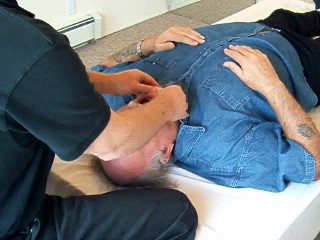
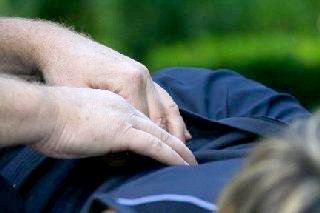
A Clinical Session
|
|
|
|
For a more complete explanation of TMJ Syndrome / TMD and
READ:
|

|
The Institute for Somatic Study and Development
Herrada Road, Santa Fe 87508 +Lawrence Gold, C.H.S.E.
Telephone 505 819-0858 | | TERMS OF USE | PRIVACY POLICY | CONTACT: |


 View Lawrence Gold's profile

 While getting a tooth crown, I noticed how I involuntarily tensed my neck muscles (and other places) during the procedure, how sore my muscles on the left inside of my jaw felt for days after, and how I chewed more on one side than the other both because of the soreness and because the temporary crown kept coming off during meals.
 Being a professional, I explored my own problem. I developed and refined exercises until I had an way out of the problem. That's this program. I no longer have a bite deviation or a catch when closing my jaws -- and neither do clients of mine with whom I have used this approach.



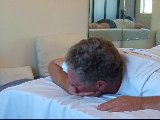
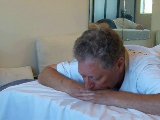 The muscles of biting and chewing coordinate closely with the muscles at the rear-top of the neck/base of the head. When you reach forward with your mouth to take a bite, these muscles are involved.
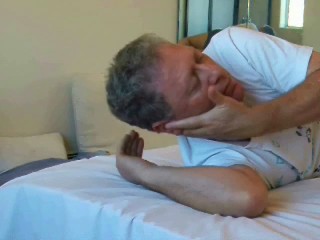
 This exercise uses a head-turned position to engage both the jaw and neck muscles, both of which are affected by trauma-conditions that lead to TMD.
 Having dealt with enmeshed neck and jaw movements during grinding movements, we now deal specifically with the grinding movement in the head position typical of most chewing.
 Movement of the lower jaw forward is part of opening the mouth widely, as in biting an apple.
 Chewing and speech involve free movements in various directions. You now test and refine all movements.

