 |
|||||||
| home | learn about your condition | about somatics | site contents | store | testimonials | about Lawrence Gold | contact |
|
||||||||||||||||||||||||||
|
How Long Does Whiplash Take to Heal?and Can Whiplash be Serious?
Lawrence Gold, Certified Hanna Somatic Educator
The Institute for Somatic Study and Development
Have a whiplash injury or other neck pain? Neck injuries have a reputation for being persistent -- but now can be resolved fairly quickly. |
|
The first thing to understand is that you may have the symptoms of a whiplash injury without having tissue damage. The pain, weakness of the neck, or dizziness of a whiplash injury often result entirely from tight neck muscles -- tightness triggered by an accident that can usually be freed fairly quickly with the right muscular training.
If a whiplash injury persists for weeks or months, it can become more serious, with consequences such as neck disc bulges or breakdown of vertebrae.
That said, let me explain some things about whiplash injuries.
At the time of your accident, muscles in your neck went into contraction to protect you against injury. When your head and neck were suddenly and violently thrown back and forth, a protective reflex, called the "stretch reflex" (or myotatic reflex, the clinical term) tightened the muscles of the neck to prevent excessive motion,
which might otherwise have fractured your neck and damaged your spinal cord. So,
those muscular contractions braced you quickly and automatically to protect
you.
In the process, the incident galvanized your whole neuromuscular system
into a heightened state of arousal; the shock of the incident created a vivid impression of an emergency situation in you -- a shock to your system. Shocks to the system tend to make lasting impressions on memory. Even though the incident was momentary, the memory persisted, and along with it, the protective, reflexive reaction. Suddenly a tension habit was formed.
Within minutes, in many cases of whiplash injury, neck muscles are fatigued and sore. That soreness, felt as neck pain, may have convinced you that you were injured, leading you to guard against head movement to prevent further pain. Guarding leads to further tension, tension leads to pain, and pain leads to a diagnosis of a whiplash injury.
Tension also leads to muscle fatigue, and muscle fatigue feels like muscle weakness.
As incidents of injury usually come from one side or the other, muscles are affected unequally. Unequal muscular tension (more tension on one side than the other) moves vertebrae more to one side: spinal misalignment. Loss of spinal alignment leads to distorted head movement and to unbalanced head position. The combination of distorted head movement and unbalanced head position send distorted sensations from the balance centers of the inner ears to the balance centers of the brain. You might feel dizzy, tight, and sore -- all from the shock of an injury causing muscles to tighten.
|
|
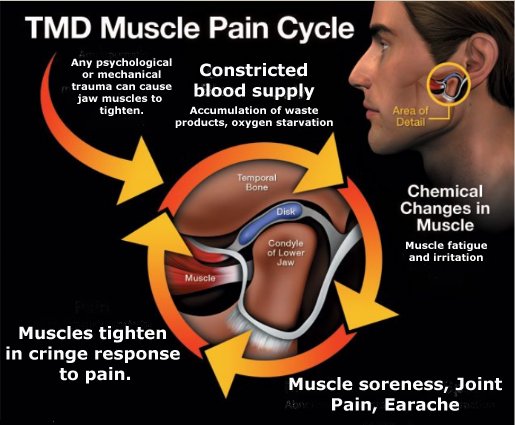
The same muscular tension also pulls the vertebrae of your neck closer together, making your neck shorter, thicker, and stiffer. Pressure on the discs increases, sometimes leading to disc bulges, disc degeneration and sometimes, to pinched nerves, with pain and numbness down the arms, possibly into the hands. The muscular tension also sometimes pulls vertebrae together closely enough that they rub in movement, producing crunching and grinding sensations. Jaw muscles also tighten as part of the protective bracing action. Sound familiar? |
|
In light of this description, the desire to lengthen a shortened, contracted neck with traction is understandable, as is the use of a whiplash collar to prevent motion of a sore neck. Though the intention to lengthen the neck makes sense, neither therapeutic approach addresses the neurological conditioning resulting from the shock of injury which causes the muscular spasticity. Traction and bracing are ineffective.
Since you are reading this article, you have probably already gone the route of standard medical diagnosis and treatment and have not gotten the desired results. Now you know why. The tensions and symptoms of whiplash (and other neck injuries) can now be ended in two to four sessions of clinical somatic education.
The process involves reclaiming control of the involved muscles through gentle and precise movements you do, guided and assisted by a Hanna Somatic Educator. This approach differs from therapies that stretch muscles or adjust vertebrae: you are in control and the results are lasting because you change your own neurological conditioning; you dispel the shock of injury and regain your freedom of movement. That's the point of this article.
If post-injury X-rays show no fracture, your problem (if you have one) probably results from neurological conditioning (shock of injury) and muscular tension. Ligamentous injury or an injury to intervertebral discs are possible, though often misdiagnosed. (Ligaments are flexible "straps" that link bones together; intervertebral discs are resilient connective tissue -- fibrocartilage -- that connects vertebrae.) If you have not healed after six months or so, the problem is almost certainly muscular, and not ligamentous. Even if such injuries exist, Hanna Somatic Education is gentle enough that no harm can be done and inexpensive enough to be worth the possibility of a (dramatically) shortened recovery time. Lawrence Gold is a certified clinical somatic educator in practice correcting whiplash and other injuries since 1990. He has been a featured speaker at numerous conferences and his articles have appeared in numerous publications. Contact him for help by clicking the envelope icon, below. |

The Institute for Somatic Study and Development
Lawrence Gold, C.H.S.E.
Publications | Credentials | Personal Page
This article may be reproduced only in its entirety. |
