|
||||||
| home | learn about your condition | about somatics | site contents | store | testimonials | contact Lawrence Gold |
|
|
|||||||||||||||||||||

Somatics: It works.
Get out of pain and feel all right, again,
This is a faster and easier way.
------- Extraordinarily Effective ~~ Extraordinarily Efficient
-------
|
||
|
If you came to this page from a search and want to know the difference between this approach and more common psoas muscle spasm treatments that rely on stretching, strengthening, and/or manipulation; if you want to know why this approach gets a better result, go here, next:
|
||
|
All Most People Need with a TWO WEEK FREE TRY-OUT PERIOD 
REFUND POLICY You'll like it. |
|
|
Can you remember the feeling of sitting, standing, and walking before your groin or hip joint started to hurt? Can you remember feeling comfortable in your groin? If you can't remember the feeling, you've lost the "muscle memory" of that state. You may be surprised, after all of your therapy, to learn that to get comfortable, again, all you need to do is restore the muscle/movement memory of healthy psoas muscles.
|
||||||
|
Do this program to regain easy, comfortable movement as your psoas muscles relax and come under your easy control. Groin pain, hip joint pain, and deep belly fade out and stay gone faster than by therapeutic methods that use stretching and/or manipulation. Walking normalizes and your comfort, when sitting, returns.
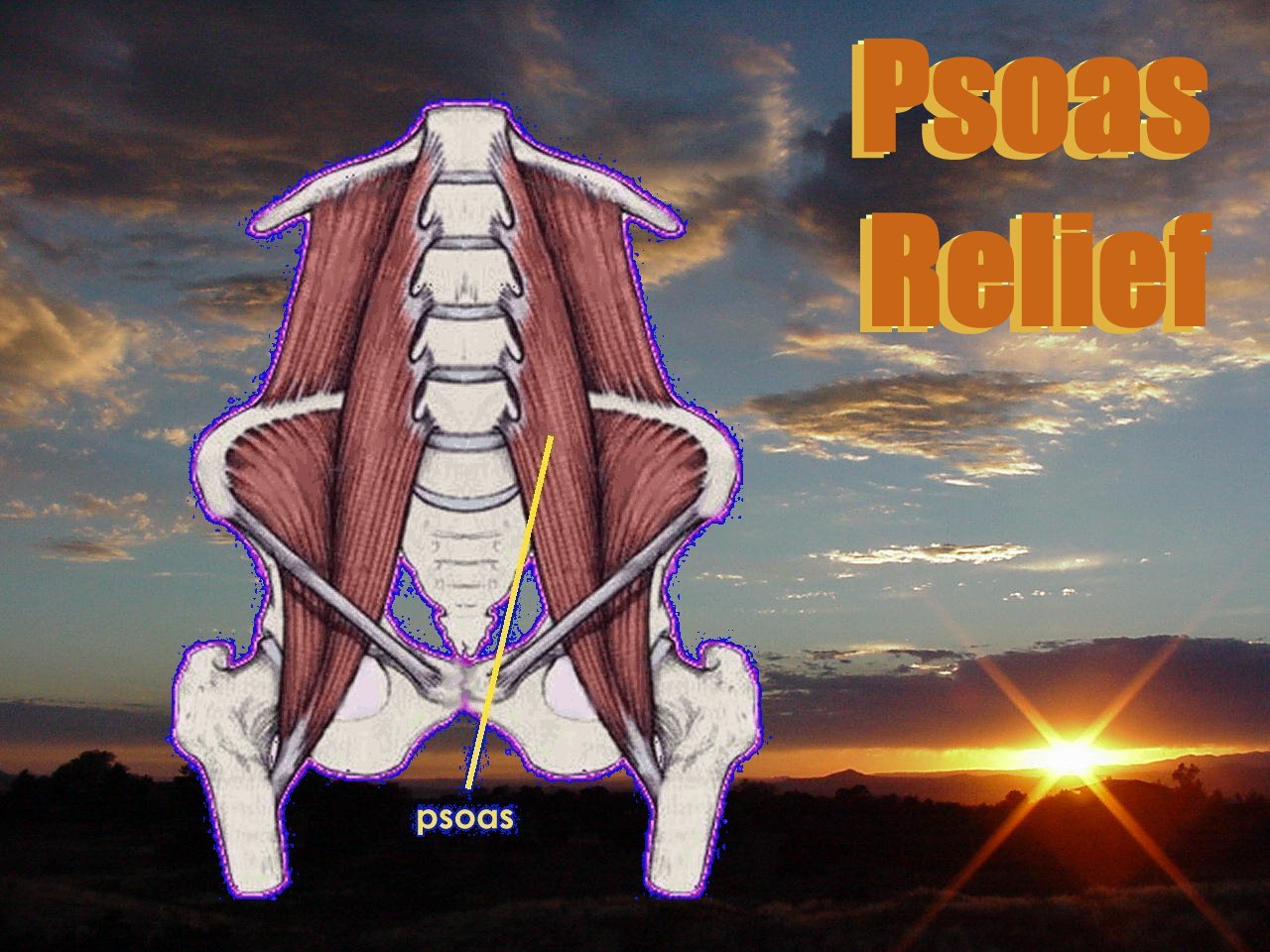
Your psoas muscles are "core" walking and sitting muscles. When tight, they cause groin pain, a tight diaphragm and
other symptoms.
Tight psoas muscles shorten your stride, prevent you from standing up straight, lead to hip joint damage, and cause pain in the groin, pelvis, and deep in the belly. Common diagnoses are groin pull, iliopsoas bursitis, iliopsoas tendinitis, and torn labrum (hip joint damage). I developed this program to produce results equivalent to what I get in my clinical practice: a 97%+ success rate.
|
( UNSOLICITED TESTIMONIAL STATEMENT )
|
|||||
FASTER, LASTING RELIEF of PSOAS MUSCLE PAIN
|
||||||
Overview of Free Your Psoas
A COMPLETELY DIFFERENT APPROACH
We can't free tight psoas muscles and make them work properly by stretching, massage or manipulation of any kind. Stretching doesn't work. The reason: our brain controls our muscles -- their tension, coordination, and movement.
Muscles have no memory of their own. The more accurate term is "muscle/movement memory." Movement (muscle) memory makes every muscle prone to return to its habitually tight state soon after any kind of stretching or manipulation. Isn't that your experience? Now, you know why.
So, instead of stretching, strengthening or manipulating, we change the movement memory of psoas muscles at their control center -- the brain -- where muscle/movement memory lives.
We don't just "release" the psoas muscles. We make them work better with the rest of your muscular system. Change the control-pattern, change function. The change affects all movement activities and works far more rapidly and comfortably than stretching or manipulation. It's also much more comfortable to do, and it lasts.
Old muscle/movement memory, OFF. New muscle/movement memory, ON.
You'll feel improvements of ease in movement that accumulates with practice.
Pain fades out as your ease of movement improves.
|
|
Exercises: Video Introductions and Explanations |
Locates and Activates the Core of which The Psoas Muscles are a Part.
Frees the Hip Joint Muscles. Removes interference from reaching the psoas muscles.
Releases the Psoas, Hip Joint, and Trunk Muscles.
A Comforting Movement
|
|
Polishing/Further Integration Movements |
||
|
|
|
Lawrence Gold on
click:
The Institute for Somatic Study and Development
Lawrence Gold | Clinical Somatic Education
| |||||||||||||||||






 After the first lesson I could feel a difference, later on I felt a muscle in my groin/stomach area release, and my right hip relax to a large degree. After each lesson, I felt better and better. The greatest thing I noticed is that, instead of feeling better and then my body starting to decline, my body did not start the decline phase. Not everything is perfect yet with me, but the areas that released stayed that way. I even feel a difference in other areas of my body like my back, neck, legs. I still want to get more lessons/DVD from the Lawrence Gold site for my back and neck. The lessons to take a bit of trial and error to understand the moves. It can be frustrating, but stick with it because it will be worth it when you're feeling better. I can't remember a time when I was feeling this good...
 6/23/2010 5:24 PM
 I didnt anticipate such a long email, please just respond whenever you have the time. I have been working with your "Freeing the Psoas" program for about 6 weeks now and have to tell you it really has done wonders. It has really opened up the groin muscles and is way more effective than the stretching I was doing months ago. The help with yoga and pilates was marginal compared to this.