|
||||||
| home | learn about your condition | about somatics | site contents | store | testimonials | contact Lawrence Gold |
|
|
|||||||||||||||||||||

|
by +Lawrence Gold
|
||||||
|
If you've already tried stretching and seen its limitations, that's good; now you know what doesn't work.
I'm offering you something different that works better than stretching and that causes your hamstrings to stay free much longer. So, let's get straight to it. The instructional video immediately below is not a stretch, but a way to reprogram muscle (movement) memory. That's why it's more comfortable to do, more effective and more lasting than a stretch. Don't turn this into a stretch or "go for that little bit extra"; that will work against you. Do it, as given.
|
||||||
|
The exercise above comes from the program, Comforting Your S-I Joints.
If you have pain in your groin, low back, and where your hamstrings attach at your "sitbones" (ischial tuberosities) you need the exercises in Comforting Your S-I Joints, which includes the exercise, above.
Hamstrings tighten up in sacro-iliac joint dysfunction, and a direct approach to freeing them doesn't help. The cause, reflexive tightening, is different from that of common tight hamstrings and you must address it differently. If your sacrum is normal, it's usually a matter of a few practice sessions for lasting improvements. If in doubt, check here.
|
|||||||
|
A
torn meniscus (knee joint crunchiness or locking up) and knee pain often come from tight hamstrings. This entry explains how that is so and what to do, about it.
|
||
|
In this write-up, I explain how tight hamstrings contribute to knee pain and cause popping in the knee joint; and how to solve the problem of tight hamstrings. |
|||
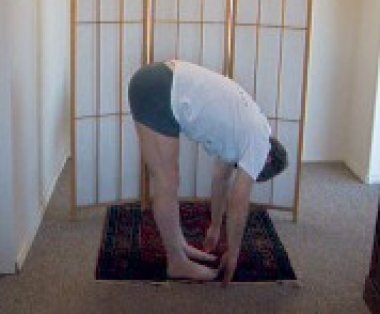
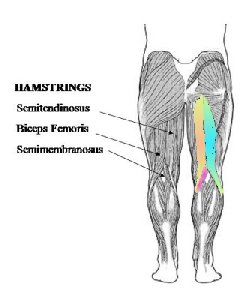
A Look at Your HamstringsThe hamstrings are the muscles that run from behind and below your knees up the backs of your thighs to your "sitbones". Soft tissue injuries, knee pain, torn menisci (the cartilage pads in your knees that cushion the bones), chondromalacia patelli (painful wearing of the cartilage behind the kneecaps), and poor posture often come from tight hamstrings.Tight hamstrings can prevent you from reaching full leg extension (though it may seem to you that your knees are as straight as they can get) or from bending over completely. If you can't touch your toes or if you feel more comfortable, when sitting, slouching than sitting up straight, your hamstrings are probably tight.
|
Get personal, live-video instruction (privately recorded for your review):
To schedule, send email with transaction ID and three good times for you.
|
||
|
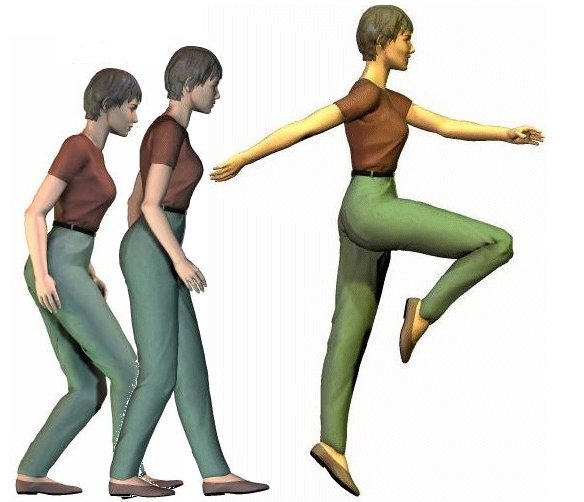
Oddly, some people actually cultivate the ability to hyperextend the backs of the legs. They consider it a point of quiet pride that they can walk on all fours, with palms touching the floor as much as the soles of their feet. One of their favorite positions, they call, "Downward Facing Dog". True. However, for some people who can do that, an oddity arises: By overstretching, some people lose the walking pattern of coordination between the back of one leg and the front of the other leg. It is an oddity, because they develop patterns of confusion of opposing muscles in which they seize up in a kind of moving-binding isometric exercise. They develop a muscular burn when they stand or walk that they register as pain -- an immobilizing cramp, actually. Which it is. And it's from interrupted and disorganized coordination and heightened effort. So mere lengthening into hyperextension is not a sufficient answer. It is, in part, a matter of length; but also, in equal part, it is a matter of control and "resting muscle tone". Such people need to develop looser "walking" coordination. If the above description -- hyperextended knees and overstretched hamstrings -- fits you, I'm now directing you to the program, SuperWalking, which develops better coordination for faster, easier walking.
A SPECIAL "TURNED SACRUM" ALERT: If you have hamstrings that just won't let go and also have pain at the groin and at the waist in the back, on one side, you may have a turned sacrum, which causes hamstrings and psoas muscles to tighten in a way that neither stretching nor the kind of exercises featured, here, can correct. You need a special somatic education exercise program, Comforting Your S-I Joints. Read this entry to see if it describes you, and act accordingly.
|
|
Stretching has been shown to produce little if any effectiveness for avoiding injury, despite its widespread popularity among coaches and athletes. How do we know? We know by the frequency of knee trouble among people who stretch, including professional athletes. We know from your own experience -- and now, we know from clinical studies.
The frequency of knee injuries among athletes, dancers, and everyone else, young or old, in any walk of life, suggests that stretches so commonly used to free and lengthen hamstrings could, let's say, be better.
|
|
||||
How Tight Hamstrings Cause Knee PainMany kinds of problems come from tight hamstrings: knee pain when or after climbing stairs, knee pain walking downhill (you know, around or in front of the kneecap), tearing of meniscal cartilage, pain under the knee cap, crepitus (crinkly cellophane in the knee), pain below the knee cap, pain behind the kneecap, and, of course, hamstring pulls and tears.Tight hamstrings add to swayback by pulling the knees backward (i.e., locking the knees). As you sway forward, your spinal curves increase. If your outer hamstrings are tighter than the inner ones, your lower leg twists toe-outward. This twist at the knee joint contributes to knee pain, to knee problems when running, to ligament (e.g., ACL) injuries, and to loss of knee cartilage (and joint replacement) surgery. You've seen (or been one of) those people who wear a hinged knee brace or bandage around the knee? Tight hamstrings are commonly the culprit. Hamstring tension has far-reaching effects on movement, balance, and the health of joints.
There are three hamstring muscles on the back of each thigh: two on the inside and one on the outside. One of the hamstring muscles, the biceps femoris, has fibers that pass into the knee joint that attach to and position the meniscus as the knee bends. When habitually tight, that muscle moves the meniscus into an abnormal position that makes it prone to get caught between the upper and lower leg bones, leading to popping, pain and tearing of the meniscus. Crepitis (crunching like crinkling cellophane) and arthroscopic surgery often follow.
When hamstrings are habitually tight, it's impossible to straighten the knee without a little extra effort from the front thigh muscles (quadriceps femoris). Without that "little extra effort", the knee stays bent enough to buckle; no support. So, the quadriceps stay tight all the time. In the process, they jam and grind the kneecap against the joint. The result: chondromalacia patelli, a knee brace from your doctor, and maybe, surgery to "clean" the surface of the kneecap. It's a little like wiping down an engine that has too much internal wear. |
Why Stretching Doesn't Work for Long (or Very Well)Your Experience?As anyone who has had someone stretch their hamstrings for them knows, stretching hamstrings this way is an ordeal to be tolerated. Then, they're a bit shaky, which they may interpret as "loose" and think, "a good thing." Stretching the hamstrings disrupts their natural coordination with the quadriceps muscles, which is why ones legs feel shaky after stretching those hamstrings.
It is to our good fortune that researchers in a long-standing tradition of somatic educators (as far back as 1880) ultimately arrived at an understanding of muscle tone and of resting muscle tone and of ways of improving self-regulation of muscle tone. Here's where we have a new insight into the situation. Stretch? or Relax? If you think you know the answer, there's something more. Hamstrings that need stretching are, obviously, too short. Why is that? How is that? Simple: those muscles are holding tension -- that is, contracting. The person is holding tense by habit, unconsciously. Oddly enough, if he or she tries to relax, (s)he is likely to find that (s)he cannot; (s)he may then assume that the muscles are completely relaxed and need stretching and go looking for someone to stretch her. Or him. She doesn't realize she's contracting those muscles "on automatic", caught in postural habits stored in her central nervous system -- memories of how to feel and how to behave. Any attempt to stretch her simply re-triggers her impulse to re-contract to restore the sense of what is "familiar" or "safe". That is why hamstrings (and other muscles) tighten up again so soon after stretching or massage. Better results come by changing the person's "set-point" -- their sense of what "relaxed" is.
|
A BETTER WAY TO SOLVE THE PROBLEMYou can do better than to stretch. Instead, break the tension habit that keeps your hamstrings getting tight again and again.
Changing the Resting Tension Set-PointTo change the set-point requires more than stretching, manipulation or massaging; it requires learning new movement/muscle-memory -- and unlearning the old muscle/movement memory. Somatic education quickly and directly accomplishes that result.What I have been leading you to, here, is a special kind of movement/muscle-memory training process called, "pandiculation". Pandiculation is a brain-retraining action related to yawning that, correctly applied, re-sets the tension set-point so that muscles relax. Pandiculation eliminates back pain, frees tight psoas muscles, resolves whiplash injuries and clears up other injuries. The following video explains about pandiculation.
|
|||
|
Using movement patterns that involve pandiculation, somatic education exercises change movement/muscle-memory, dissolve the automatic grip of habitual and excessive tension patterns from repetitive use or injury, extinguish pain, and activate better control of movement. Improvements you can feel and others can see begin quickly with somatic education exercise practice and accumulate with further practice. Somatic Education Exercises are maintain a healthy "young adult" quality of movement and reduce stress. |
|
||
|
|
|